






1. A creative learner refers to one who is
(CTET 2011)
(a) very talented in drawing and painting
(b) highly intelligent
(c) capable of scoring consistently good marks in tests
(d) good at lateral thinking and problem solving
Answer: (d) good at lateral thinking and problem solving
2. Development of concepts is primarily a part of (CTET 2011)
(a) emotional development
(b) intellectual development
(c) physical development
(d) social development
Answer: (b) intellectual development
3. Theory of learning which totally and only depends on ‘observable behaviour’ is associated with theory of learning.
(CTET 2011)
(a) Cognitivist
(b) Developmental
(c) Behaviourist
(d) Constructivist
Answer: (c) Behaviourist
4. Human development is based on certain principles. Which of the following is not a principle of human development?
(CTET 2011)
(a) Continuity
(b) Sequentiality
(c) General to Specific
(d) Reversible
Answer: (d) Reversible
5. Understanding the principles of development of a child helps a teacher in
(CTET 2011)
(a) identifying the social status of the learner
(b) identifying the economic background of the learner
(c) rationalizing why the learner ought to be taught
(d) effectively catering to the different learning styles of learners
Answer: (d) effectively catering to the different learning styles of learners
6. The statement: ‘An important precondition for the proper development of a child is ensuring her/his healthy physical development’
(CTET 2011)
(a) is untrue as physical development does not affect other domains of development in anyway
(b) may be incorrect as development varies from individual to individual
(c) is true because physical development occupies the topmost place In the sequence of development
(d) is true because physical development is interrelated with other domains of development
Answer: (d) is true because physical development is interrelated with other domains of development
7. Seema learns every lesson very quickly but Leena takes longer to learn them. It denotes the developmental principle of
(CTET Jan. 2012)
(a) inter-relationships
(b) continuity
(c) general to specific
(d) individual differences
Answer: (d) individual differences
8. Development starts from
(CTET Jan. 2012)
(a) pre-natal stage
(b) the stage of infancy
(c) pre-childhood stage
(d) post-childhood stage
Answer: (a) pre-natal stage
9. The stage of cognitive development according to Piaget, in which a child displays ‘object permanence’ is
(CTET Jan. 2012)
(a) Formal operational stage
(b) Sensorimotor stage
(c) Pre-operational stage
(d) Concrete operational stage
Answer: (b) Sensorimotor stage
10. Knowledge of ___________ will be most significant for a teacher dealing with a class comprising students of mixed age groups.
(CTET Nov. 2012)
(a) socio-economic background
(b) cultural background
(c) developmental stages
(d) occupation of their parents
Answer: (c) developmental stages
11. Systematic presentation of concepts may be related with which of the following principles of development?
(a) Development proceeds from heteronomy to autonomy
(CTET Nov. 2012)
(b) Students develop at different rates
(c) Development is relatively orderly
(d) Development leads to growth
Answer: (c) Development is relatively orderly
12. Even though this was clearly in violation of his safety needs, Captain Vikram Batra died fighting in the Kargil War while protecting his country. He might have (CTET July 2013)
(a) sought novel experience.
(b) achieved self-actualisation.
(c) ignored his belongingness needs.
(d) wanted to earn a good name to his family.
Answer: (b) achieved self-actualisation.
13. Which one of the following is correctly matched?
(CTET July 2013)
(a) Physical Development – Environment
(b) Cognitive Development – Maturation
(c) Social Development – Environment
(d) Emotional Development – Maturation
Answer: (c) Social Development – Environment
14. All the following facts indicate that a child is emotionally and socially fit in a class except
(CTET July 2013)
(a) develop good relationships with peers
(b) concentrate on and persist with challenging tasks
(c) manage both anger and joy effectively
(d) concentrate persistently on competition with peers
Answer: (d) concentrate persistently on competition with peers
15. Which of the following statements support role of environment in the development of a child ?
(CTET July 2013)
(a) Some students quickly process information while others in the same class do not.
(b) There has been a steady increase in students’ average performance on IQ tests in last few decades.
(c) Correlation between IQs of identical twins raised in different homes is as high as 0.75 .
(d) Physically fit children are often found to be morally good.
Answer: (b) There has been a steady increase in students’ average performance on IQ tests in last few decades.
16. Which of the following figures correctly represents the development according to Piaget’s developmental theory?
(CTET Feb. 2014)
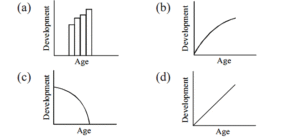
Answer: (a)
17. A teacher found that a student is facing difficulty in drawing a square. He/ She assumes that this student would also find it difficult to draw a diamond. He/She applies which of the following principles to arrive at his/ her assumption?
(CTET Feb. 2014)
(a) Development tends to follow an orderly sequence
(b) Development is saltatory
(c) Development is gradual
(d) Development is different for different people
Answer: (a) Development tends to follow an orderly sequence
18. Which one of the following statements is true regarding the role of heredity and environment in human development?
(CTET Feb. 2014)
(a) The role of environment is almost fixed, whereas the impact of heredity can be altered
(b) The theories based on the ‘behaviourism’ are largely based on the role of ‘nature’ in human development
(c) The relative effects of heredity and environment vary in different areas of development
(d) The policy of compensatory discrimination of the Government of India is based on the role of ‘nature’ in human development
Answer: (c) The relative effects of heredity and environment vary in different areas of development
19. Developmental perspective of teaching demands teachers to
(CTET Sept. 2014)
(a) be strict disciplinarians as children experiment quite frequently
(b) adapt instructional strategies based on the knowledge of developmental factors
(c) treat children in different developmental stages in an equitable manner
(d) provide learning that results in the development of only the cognitive domain
Answer: (b) adapt instructional strategies based on the knowledge of developmental factors
20. Which one of these is a principle of child development ‘?
(CTET Feb. 2015)
(a) Development can accurately predict the pace of each individual child.
(b) Development occurs due to interaction between maturation and experience.
(c) Experience is the sole determinant of development.
(d) Development is determined by reinforcement and punishment.
Answer: (b) Development occurs due to interaction between maturation and experience.
21. What term/Phrase does Piaget use for ‘mental structures which are the building blocks of thinking’? (CTET Sept. 2015)
(a) Zones of development
(b) Gene
(c) Maturation blocks
(d) Schemas
Answer: (d) Schemas
22. Development of the capacity for abstract scientific thinking is a characteristic of:
(CTET Sept. 2015)
(a) Pre-operational stage
(b) Concrete operational stage
(c) Formal operational stage
(d) Sensori-motor stage
Answer: (c) Formal operational stage
23. Which one of the following statements best sums up the relationship between development and learning ? (CTET Sept. 2015)
(a) Learning and development are inter-related in a complex manner.
(b) Development is independent of learning.
(c) Learning trails behind development.
(d) Learning and development are synonymous terms.
Answer: (a) Learning and development are inter-related in a complex manner.
24. Which one of these is NOT a principle of development ?
(CTET Sept. 2015)
(a) Development is influenced by both heredity and environment.
(b) Development is modifiable.
(c) Development is governed and determined by culture alone.
(d) Development is life-long.
Answer: (c) Development is governed and determined by culture alone.
25. The cognitive ability that comes in pre-operational period is
(CTET Feb. 2016)
(a) ability for abstract thinking.
(b) hypothetico-deductive thinking.
(c) ability of goal-directed behaviour.
(d) ability to take other’s perspective.
Answer: (d) ability to take other’s perspective.
26. Which one of the following statements about development is correct?
(CTET Feb. 2016)
(a) Developmental changes go forward in a straight line.
(b) Development proceeds from birth to adolescence in a forward manner and then it goes backwards.
(c) Development occurs at a different rate among different Individuals.
(d) Development occurs at a very fast pace from birth till adolescence and then it stops.
Answer: (c) Development occurs at a different rate among different Individuals.
27. Middle childhood is the period from (CTET Feb. 2016)
(a) birth to 2 years
(b) 10 years onwards
(c) 2 years to 6 years
(d) 6 years to 11 years
Answer: (d) 6 years to 11 years
28. “Environmental factors do not play any role in shaping an individual, since growth of each individual is determined by his genetic makeup.” This statement is
(CTET Feb. 2016)
(a) correct, since genetic makeup of an individual is very strong.
(b) incorrect, since there have been several researches to prove that environment can have a major influence on development.
(c) correct, since there have been several researches to prove that genetic material alone predicts an individual’s development.
(d) incorrect, since environmental factors contribute little in an individual’s growth and development.
Answer: (b) incorrect, since there have been several researches to prove that environment can have a major influence on development.
29. ….. is a process through which a human infant begins to acquire the necessary skill to perform as a functioning member of the society.
(CTET Feb. 2016)
(a) Socialisation
(b) Development
(c) Learning
(d) Maturation
Answer: (a) Socialisation
30. Which of the following statements about principles of development is incorrect?
(CTET Sept. 2016)
(a) Development is a quantitative process which can be measured precisely.
(b) Development depends on maturation and learning.
(c) Development takes place due to a constant interaction between heredity and environment.
(d) Every child goes through stages of development, yet there are wide individual differences among children.
Answer: (a) Development is a quantitative process which can be measured precisely.
31. The unique interaction of _________ and _________ can result in different paths and outcomes of development. (CTET Sept. 2016)
(a) exploration; nutrition
(b) challenges; limitations
(c) heredity; environment
(d) stability; change
Answer: (c) heredity; environment
32. The development from central part of the body towards peripheries or extremities denotes the
(CTET Dec. 2018)
(a) principles of decentralized development
(b) principles of proximodistal development
(c) principles of cascade development
(d) principles of radiated development
Answer: (b) principles of proximodistal development
33. Between ______________ months of age, most children begin to combine words into short sentences while speaking.
(CTET Dec. 2018)
(a) 18 and 24
(b) 24 and 30
(c) 30 and 36
(d) 12 and 18
Answer: (a) 18 and 24
34. To understand individual differences in development it is important
(CTET July 2019)
(a) to look at the environmental factors that affect individuals.
(b) to consider maturation of the body and the brain.
(c) to consider both inherited characteristics as well as environmental factors and their interplay.
(d) to look at the inherited characteristics that give each person a special start in life.
Answer: (c) to consider both inherited characteristics as well as environmental factors and their interplay.
35. Which of the following is not a principle of development?
(CTET July 2019)
(a) Development is relatively orderly.
(b) Development takes place gradually over a period of time.
(c) Exact course and nature of development is determined at the time of birth itself.
(d) Individuals develop at different rates.
Answer: (c) Exact course and nature of development is determined at the time of birth itself.
36. One of the major accomplishments of concrete operational stage is
(CTET July 2019)
(a) Ability to conserve
(b) Hypothetic – deductive reasoning
(c) Secondary circular reactions
(d) Animistic thinking
Answer: (a) Ability to conserve
37. Noor forgot to bring her tiffin to school and asked Tanya to share her tiffin saying “You should share your tiffin with me today because I shared my tiffin with you yesterday”. According to Lawrence Kohlberg’s theory of moral development, Noor’s statements represents ________ orientation typical at _________ stage.
(CTET Dec. 2019)
(a) law and order : post-conventional
(b) obedience; pre-conventional
(c) being nice; conventional
(d) exchange; conventional
Answer: (d) exchange; conventional
38. Constructivist approach suggests that ________ is crucial for constructing knowledge.
(CTET Dec. 2019)
(a) prior knowledge of the learner
(b) conditioning
(c) punishment
(d) rote memorization
Answer: (a) prior knowledge of the learner
39. During the period of childhood, development –
(CTET Jan. 2020)
(a) consists only of quantitative changes.
(b) is disorderly and disjointed.
(c) is slow and cannot be measured.
(d) is multilayered and complex.
Answer: (d) is multilayered and complex.
40. The nature of relationship between development and learning is viewed by Lev Vygotsky as having which of the following characteristics?
(CTET Dec. 2021)
(a) It is linear in nature
(b) The relationship is static in nature
(c) Learning often precedes development
(d) Development often precedes learning
Answer: (c) Learning often precedes development
41. The developmental theorists who view process of development as having substantial plasticity throughout life are likely to emphasize the importance of : (CTET Dec. 2021)
(a) Heredity
(b) Environment and experience
(c) Domain specific intelligence
(d) Crystallized intelligence
Answer: (b) Environment and experience
42. ‘Discontinuity’ in the developmental process refers to
(CTET Dec. 2021)
(a) New ways of understanding the world that emerge during the process of development.
(b) Negative breaks in the developmental process.
(c) A downward negative trend in development.
(d) Interference in the developmental process
Answer: (a) New ways of understanding the world that emerge during the process of development.
43. Authoritative style of parenting / child rearing is based on:
(CTET Dec. 2021)
(a) Making decisions for the child
(b) Not listing to a child’s point of view
(c) Making unreasonable demands from the child
(d) Engage in joint decision making wherever possible
Answer: (d) Engage in joint decision making wherever possible
44. “Success” in schools should be broadened beyond specific academic achievement within school to include:
(CTET Dec. 2021)
(a) Training given by coaching institutions
(b) Development of socio – emotional capacities as an important part of education.
(c) Extra tests which can be done at home
(d) Constant focus only on areas where a child is ‘weak’
Answer: (b) Development of socio – emotional capacities as an important part of education.
45. The social expectations at each stage of development is referred to as
(CTET 3 Jan. 2022)
(a) Developmental tasks
(b) Developmental needs
(c) Developmental hazards
(d) Developmental domains
Answer: (a) Developmental tasks
46. Development_________________ .
(CTET 3 Jan. 2022)
(a) proceeds from centre of the body in an outward direction.
(b) development proceeds from bottom to top.
(c) is unidimensional.
(d) is not influenced by environmental efforts.
Answer: (a) proceeds from centre of the body in an outward direction.
47. Assertion (A) : Cognitive development progresses quite rapidly till middle childhood and then comes to a stop. Reason (R) : Human beings cannot learn new things after the stage of middle childhood.
(CTET 3 Jan. 2022) Choose the correct option.
(a) Both (A) and (R) are true and R is the correct explanation of (A).
(b) Both (A) and (R) are true but R is not the correct explanation of (A).
(c) (A) is true but (R) is false.
(d) Both (A) and (R) are false.
Answer: (d) Both (A) and (R) are false.
48. Which principle of development suggests that different body systems grows at different rates? (CTET 8 Jan. 2022)
(a) The cephalocaudal principle
(b) The proximodistal principle
(c) The principle of hierarchical integration
(d) The principle of independence of systems
Answer: (d) The principle of independence of system
50. Developmental changes –
(CTET 8 Jan. 2022)
(a) are highly unpredictable.
(b) occur very fast till middle childhood then reach a plateau and stop.
(c) occur at varying rates in individuals.
(d) are independent of the socio-cultural context
Answer: (c) occur at varying rates in individuals.
51. A child’s growth and development is influenced by:
(CTET Feb. 2022)
(i) Parenting styles
(ii) genetic make-up
(iii) Schooling experiences(iv) Personal interests
(a) (ii), (iii)
(b) (i), (ii)
(c) (i), (iii), (iv)
(d) (i), (ii), (iii), (iv)
Answer: (d) (i), (ii), (iii), (iv)
52. Development changes in children:
(CTET Feb. 2022)
(a) Are universal taking place at the same pace across cultures.
(b) Are unidimensional and linear..
(c) Are a complex interaction between hereditary and environmental factors.
(d) Are irreversible and proceed from toe to head.
Answer: (c) Are a complex interaction between hereditary and environmental factors.
53. Assertion (A): All children across cultures proceed through the stages of development in the same manner at the same age.
(CTET Feb. 2022)
Reason (R): Childhood is universal and unidimensional. Choose the correct option.
(a) Both (A) and (R) are true and (R) is the correct explanation of (A).
(b) Both (A) and (R) are true and (R) is not the correct explanation of (A).
(c) (A) is true but (R) is false.
(d) Both (A) and (R) are false.
Answer: (d) Both (A) and (R) are false.
54. Seema is scared to eat sweets from the kitchen without her mother’s permission. She thinks that if her mother gets to know about it then she will be punished. Identify the state of morel development of Seema according to Kohlberg’s theory of Moral development.
(CTET Feb. 2022)
(a) Post Conventional State
(b) Pre-Conventional State
(c) Formal State
(d) Conventional State
Answer: (b) Pre-Conventional State
55. As a teacher how would you facilitate problem solving abilities in your students?
(CTET Feb. 2022)
(a) By Generating fear
(b) By Generating stress
(c) By Encouraging passive and repeated memorisation of content
(d) By Encouraging brainstorming and use of strategies such as analogies and heuristics
Answer: (d) By Encouraging brainstorming and use of strategies such as analogies and heuristics
56. Read the following statements and choose the correct option:
(CTET Aug. 2023)
Assertion (A): Considerable variation exist in developmental rates among children.
Reason (R): Developmental differences are an inevitable result of complex interaction of genetic and experiential variations.
(a) (A) is true, but (R) is false.
(b) Both (A) and (R) are true, but (R) is not the correct explanation of (A).
(c) Both (A) and (R) are false.
(d) Both (A) and (R) are true and (R) is the correct explanation of (A).
Answer: (d) Both (A) and (R) are true and (R) is the correct explanation of (A).
57. Which principle of development is illustrated in the following statement?
(CTET Aug. 2023)
“Children who are deprived of a conductive environment for learning language in their early years have some difficulty in picking later in life.”
(a) Development of language is totally dependent on genetics.
(b) Language and cognition are complexly interrelated.
(c) Development is disorderly and unpredictable.
(d) There is a sensitive period of language development.
Answer: (d) There is a sensitive period of language development.
58. Assertion (A) : There is no objectively definable movement when a child enters middle childhood or adolescence.
Reason (R) : Development is continuous in nature. Choose the correct option.
(CTET Jan. 2024)
(a) Both (A) and (R) are true but (R) is not the correct explanation of (A).
(b) (A) is true but (R) is false.
(c) Both (A) and (R) are false
(d) Both (A) and (R) are true and (R) is the correct explanation of (A).
Answer: (d) Both (A) and (R) are true and (R) is the correct explanation of (A).